Why Digital Resilience Matters Now
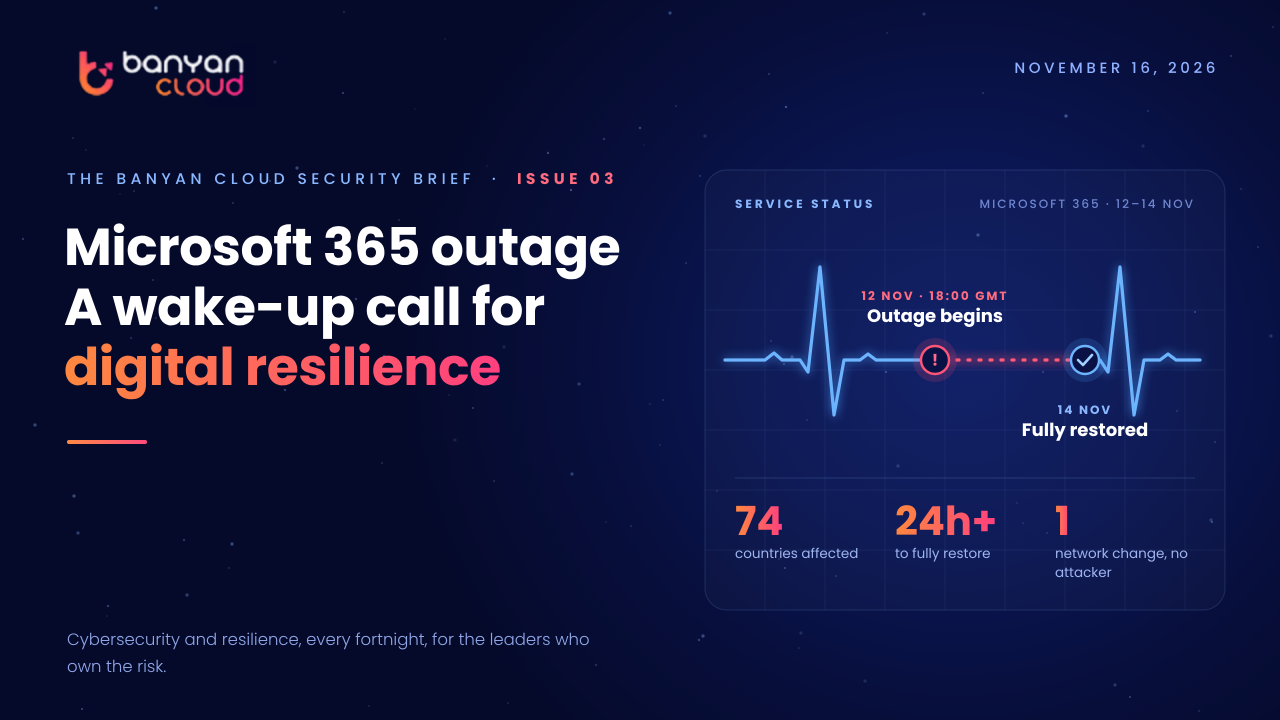
On 12 November, Outlook, Teams and Copilot went down for millions of people in at least 74 countries. There was no attacker. A network change inside Microsoft was enough to stop email for governments, police forces and businesses for more than a day.
That is the case for digital resilience: the ability to keep operating, and to recover quickly, when the technology you depend on fails, whatever the cause. Security keeps attackers out. Resilience is what keeps the business running when something gets through, or when a provider, a platform or a device simply stops working.
This issue looks at the fortnight through that lens: a global cloud outage, a crypto theft that began with a job interview, stolen secrets on developer platforms, sabotaged supermarket freezers, and the long road to post-quantum security.
Nagesh Konduru, CEO & Founder, Banyan Cloud
THIS FORTNIGHT IN 60 SECONDS
A global outage with no attacker. Outlook, Teams and Copilot were disrupted in at least 74 countries for more than a day after a Microsoft network change went wrong.
A job interview led to a US$6.3 billion theft. Binance says attackers spent five months inside employee computers, helped by a fake recruiter, before draining its hot wallets.
AI developer platforms leaked their customers' keys. Northflank told customers to assume every stored environment variable had been decrypted, and stolen AI keys were abused within hours.
Cyberattacks reached the freezer aisle. Supermarket fridges and freezers were remotely overheated across Europe, and France blamed an Iranian Revolutionary Guards unit for an earlier wave.
Old code, new exploits. Long-standing flaws in WordPress and in SSH logins on some Linux systems are now being actively exploited.
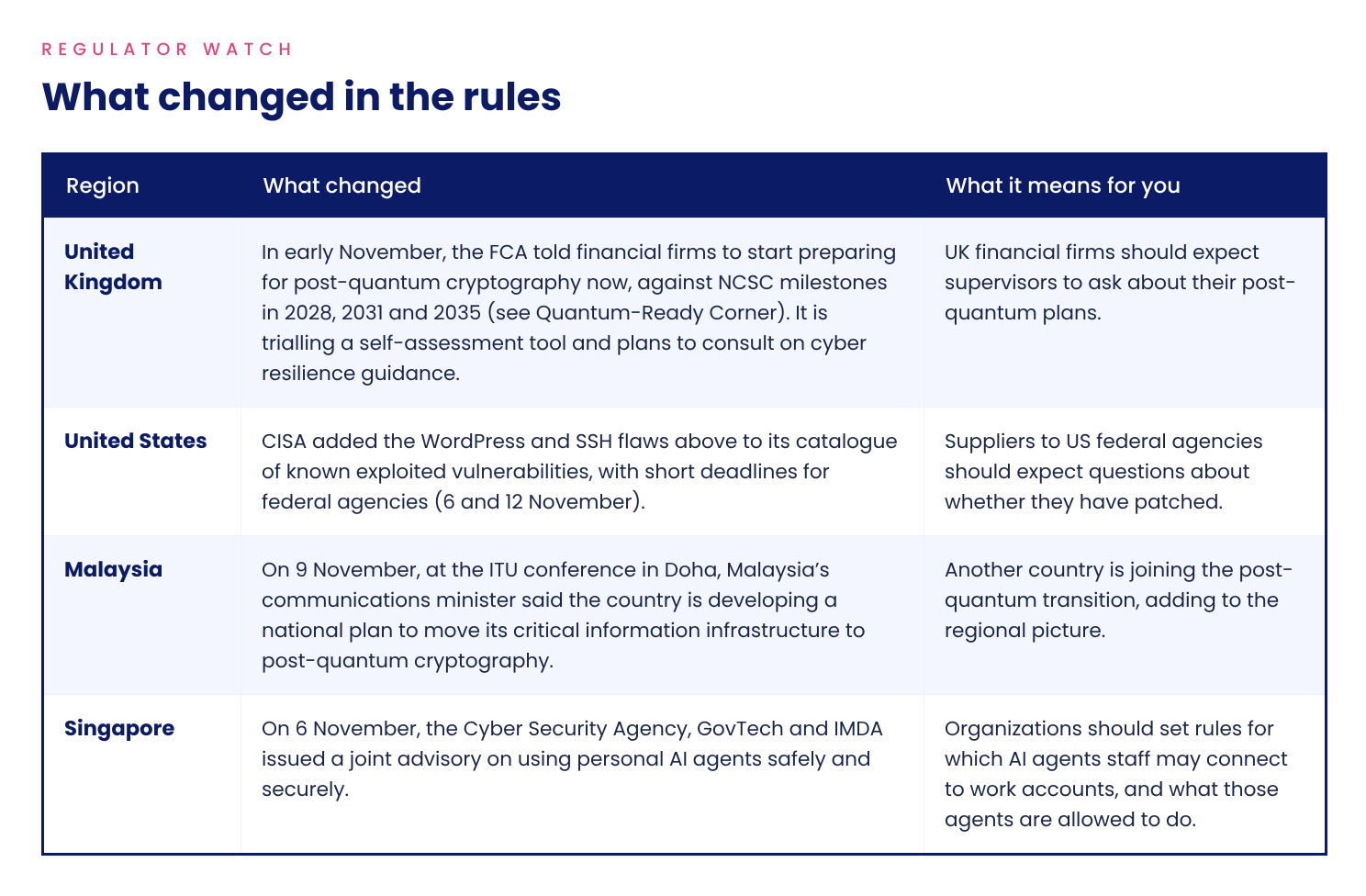
Post-quantum deadlines get closer to home. The UK's Financial Conduct Authority told firms to start preparing now, against milestones in 2028, 2031 and 2035.
THREAT RADAR
The five developments we think matter most, and what to do about each.
- Microsoft 365 outage: resilience is not only about attackers
What happened. From about 18:00 GMT on 12 November, users around the world lost access to Outlook mailboxes, and Teams, Copilot and some Azure services were disrupted. Within an hour Downdetector had reports from 74 countries and territories, with Outlook reports in the US peaking above 131,000. Government systems in Singapore and Japan, the Philippine Supreme Court, Australian federal agencies and UK councils and police services were among those affected, along with third-party services built on Microsoft's platform. Microsoft said servers had become unavailable and a core process was overwhelmed, later linking the incident to a network capacity upgrade that surfaced after a recent network change. Engineers deployed a fix to an authentication and routing component, and Microsoft said there was “no indication” of a cyberattack. On 14 November, Microsoft said services had been restored for all remaining customers and regions, well over 24 hours after the outage began. Its security tool Defender XDR was among the services affected. The outage follows other Microsoft 365 outages earlier this year.
Why it matters. Email, chat and AI assistants are now as essential as electricity for most organizations, and many rely on a single provider for all three. When that provider fails, there is often no fallback: no other way to reach staff, customers or regulators. Restored servers failing again the next morning showed that recovery can take far longer than expected, and with security monitoring tools affected too, organizations also had less visibility while it lasted.
What to do. See this issue's Cloud Risk Spotlight.
- Binance: how a job interview became a US$6.3 billion theft
What happened. On 3 November, Binance published its report on the theft of about US$6.3 billion from its internet-connected “hot” wallets on 29 October, the largest crypto theft on record. The attackers first got in during June, when a wallet engineer downloaded a compromised developer tool. In September, a second engineer who was job hunting was approached by a fake recruiter and, after several interview rounds, asked to download a coding test containing malware. On 20 October the attackers used that computer and an internal AI tool to take over the systems of two wallet developers, and nine days later used stolen credentials to run a malicious script against Binance's wallet-signing service. The FBI attributes the attack to North Korea's TraderTraitor group, which North Korea denies. By 3 November about US$2.85 billion had been frozen or intercepted, and Binance has pledged to cover all customer losses.
Why it matters. No single control failed in a dramatic way. Patient attackers worked through ordinary habits: searching for a tool online, taking a job interview, running a test file. They then used an internal AI tool to move faster once inside. Developer laptops and internal tools with broad access are now as valuable to attackers as production servers.
What to do. Treat developer and administrator devices as high-value systems, with strict controls on installing software. Warn staff about fake recruiters and coding tests, and give them a safe, isolated place to open unknown files. Review what your internal AI tools can access and do on behalf of a user. Require more than one person, on separate devices, to approve high-value or irreversible actions.
- AI developer platforms: the secrets in your environment variables
What happened. On 30 October, cloud hosting platform Northflank told customers to “assume all environment variables have been decrypted” after a breach, and to rotate every key. That evening, customers reported unauthorised use of AI service keys they had stored there. Northflank says the attack was contained within an hour and focused on control-plane secrets, but has not yet said how the attacker got in. Trigger.dev disclosed on 1 November that an attacker had accessed environment variables for some of its customers, and Railway reported a similar breach in October. Cloud security firm Wiz counted at least nine incidents at AI developer platforms during October.
Why it matters. Environment variables often hold the most powerful credentials an organization has: database passwords, cloud keys and AI service keys. Stolen AI keys can be resold or used to run up large bills within minutes. When the platform storing those secrets is breached, every customer has to rotate everything, quickly.
What to do. List the secrets you store on third-party platforms and who owns each one. When a platform reports a breach, rotate keys at the original provider, not just inside the platform, and check usage and billing logs. Prefer short-lived credentials where supported, give each application its own narrowly scoped keys, and set spending limits and alerts on AI service keys.
- Fridges and freezers: when connected devices become targets
What happened. On 2 November, fridges and freezers in more than 100 shops across several European countries were remotely overheated, following a wave that hit hundreds of French supermarkets in October. Retailers in Belgium, Luxembourg, Sweden and Ireland reported spoiled food, and Belgian prosecutors have opened a criminal investigation. On 9 November, France attributed the 11 October attacks, which targeted about 700 commercial sites and caused at least 15 fires, to Shahid Kaveh, an offensive cyber unit tied to Iran's Revolutionary Guards. It summoned Iran's ambassador, and Paris prosecutors have requested international arrest warrants. Responsibility for the November wave has not been established. France's cyber agency ANSSI has pointed to exposed administration interfaces and weak passwords. On 10 November, the head of the EU's cyber security agency ENISA warned that home appliances could be next.
Why it matters. Refrigeration and building controls are often managed remotely by third parties, reachable from the internet, running software past its end of life and protected by weak passwords. They rarely appear in an IT security inventory, yet an attack on them causes real financial and physical damage.
What to do. List every connected device that controls a physical process, including those managed by suppliers. Take them off the open internet and put them behind a secure remote access service. Change default passwords, replace or isolate devices that no longer receive updates, and make sure your supplier contracts cover security and incident reporting.
- Old code, new exploits
What happened. Two long-standing flaws are now being actively exploited. In WordPress, a race condition in the core updater (CVE-2026-119977) lets an attacker run code on a site during an update; it affects versions 4.7 to 7.1.3 and was fixed in 7.1.4 on 28 October. CISA added it to its catalogue of exploited vulnerabilities on 3 November. Separately, a flaw nicknamed “sshole” (CVE-2026-12315) lets attackers log in over SSH to some Linux systems, including Alpine and OpenWrt, by entering any password longer than 256 characters. CISA confirmed exploitation and set federal agencies a deadline of 12 November.
Why it matters. Both flaws sat unnoticed for years in widely used software, often in default settings. They show how much risk lives in code nobody has looked at recently, especially in embedded devices, containers and websites that are rarely updated.
What to do. Confirm WordPress sites are on 7.1.4 or the latest release for their branch, rather than assuming automatic updates have worked. Find any Alpine, OpenWrt or similar systems running SSH, apply the fixes, and disable password logins in favour of keys where you can.
REGULATOR WATCH
REGIONAL SPOTLIGHT: MIDDLE EAST
Regional cooperation in focus
Bahrain: On 12 November, Bahrain's National Cyber Security Centre hosted the sixth GCC Cybersecurity Exercise. Cyber security specialists from GCC member states worked through incident detection, investigation and response, including malware analysis, log and network traffic analysis and threat hunting, with an executive track for senior government officials.
Qatar: Qatar's National Cyber Security Agency announced on 14 November that Doha will host the third regular session of the Arab Cybersecurity Ministers Council on 26 November. Ministers and heads of national cyber security authorities from Arab states are expected to adopt resolutions advancing the Arab Cybersecurity Strategy.
REGIONAL SPOTLIGHT: INDIA
New AI audit rules, and a warning to the financial sector
AI Security Auditing Guidelines: On 4 November, CERT-In published its AI Security Auditing Guidelines, a 107-page framework covering AI systems developed, used or operated in India, or that process Indian data. Systems are placed in one of four risk tiers, with audit requirements ranging from self-assessment for low-risk systems to independent audits, continuous monitoring and red-teaming for critical ones. The guidelines include specific checks for AI agents, such as excessive permissions, unsafe tool use and prompt injection.
Crafty Falcon: The same day, CERT-In issued advisory CIAD-2026-0058 on “Crafty Falcon”, a critical-rated, AI-assisted campaign targeting banks, NBFCs, fintechs, payment providers and crypto exchanges. According to the advisory, attackers enter through exposed cloud infrastructure and weak testing environments, abuse payment and disbursement APIs, test routes with transactions as small as ₹1, and sometimes strike at weekends and on holidays.
Telecom security review: The Department of Telecommunications has held several rounds of discussions with Reliance Jio, Bharti Airtel, Vodafone Idea and BSNL to review network security in light of AI-driven threats. Officials say no unusual incident has been detected at any operator.
CLOUD RISK SPOTLIGHT
Plan for the day your cloud goes quiet
Most organizations have tested what happens if a server fails. Far fewer have tested what happens if their email, chat and identity provider all go down at once, which is what many Microsoft 365 customers experienced this week. Digital resilience means deciding in advance how you will keep working, and practicing it.
Five checks for this fortnight
- Map your critical business services to the providers they depend on and reduce dependence on any single one by spreading critical workloads across more than one provider, using multi-cloud or hybrid cloud where it makes sense.
- Keep independent backup, disaster recovery and business continuity capabilities, including a way to reach staff, customers and regulators that does not rely on your main email or chat platform.
- Run continuous security governance, risk visibility and proactive monitoring, including independent checks on your providers' health rather than an admin portal that may be down with the service.
- Test failover and recovery regularly across critical business services. A tabletop exercise on a day-long outage of your main productivity or cloud platform is a good place to start.
- Agree an outage playbook: who decides, how you communicate, what you switch to, and when you notify customers or regulators.
Resilience starts with seeing how your data, services and dependencies connect.
QUANTUM-READY CORNER
Regulators move from “someday” to dates
In early November, the UK's Financial Conduct Authority turned the National Cyber Security Centre's post-quantum timeline into a clear message for financial firms. Firms should have a full migration plan by 2028, carry out their highest-priority migrations by 2031, and complete migration of all systems, services and products by 2035. The FCA said firms should not wait for those milestones, should start by identifying where and how they use cryptography, and should make sure senior managers set aside enough time and budget. It noted that failed change projects caused about a fifth of the incidents reported to it in 2025, a warning against rushing migration later.
The UK joins the US, where NIST published its final transition guidance in late October, and a growing list of countries building national plans, now including Malaysia. For organizations working across borders, the common first step is unchanged: an inventory of the cryptography you use, sometimes called a cryptographic bill of materials (CBOM).
Three questions to ask your team
- Could we produce a draft post-quantum migration plan by 2028, and who would own it?
- Do we know which of our suppliers will need to change their cryptography before we can change ours?
- Have we budgeted for cryptographic changes in the next two years, or are we assuming they come later?
HYGIENE TIP OF THE FORTNIGHT
A job offer can be a trap
If someone you don't know offers you a job and asks you to download a file, run a coding test or install an app, slow down. Check that the company and recruiter are real through an independent source, and never open such files on a work device. If in doubt, tell your security team: attackers used exactly this trick in the Binance theft.
THE BANYAN CLOUD VIEW
A wake-up call for digital resilience
The Microsoft outage shows how much our digital world now depends on a handful of technology providers. This was not a cyberattack; Microsoft traced it to a network change. Still, its global impact raises a basic question: are we building a connected world that is truly resilient, or one that is more and more exposed to single points of failure?
The greatest risk in our digital world is not just a cyberattack. It is critical digital infrastructure concentrated in too few places, without enough resilience. The other stories in this issue make the same point from different angles: one engineer's laptop at Binance, one platform holding thousands of customers' secrets, one outdated controller running a supermarket's freezers. Each was a single point that, once it failed, took much more down with it.
As enterprises speed up cloud adoption and AI-driven transformation, resilience has to be built in from the start, not added after something breaks. At Banyan Cloud, we believe cybersecurity and operational resilience must go hand in hand. Protecting digital infrastructure is not only about stopping attacks; it is about keeping the business running when technology fails.
The future of digital transformation is not only about innovation and scale. It is about trust, resilience and the ability to withstand disruption. How is your organization preparing for its next major outage?
About the author
The Cloud Native Application Protection Platform built on the Zero Trust & Data Security First principles
Comments
Join the discussionNo comments yet. Be the first to comment.